
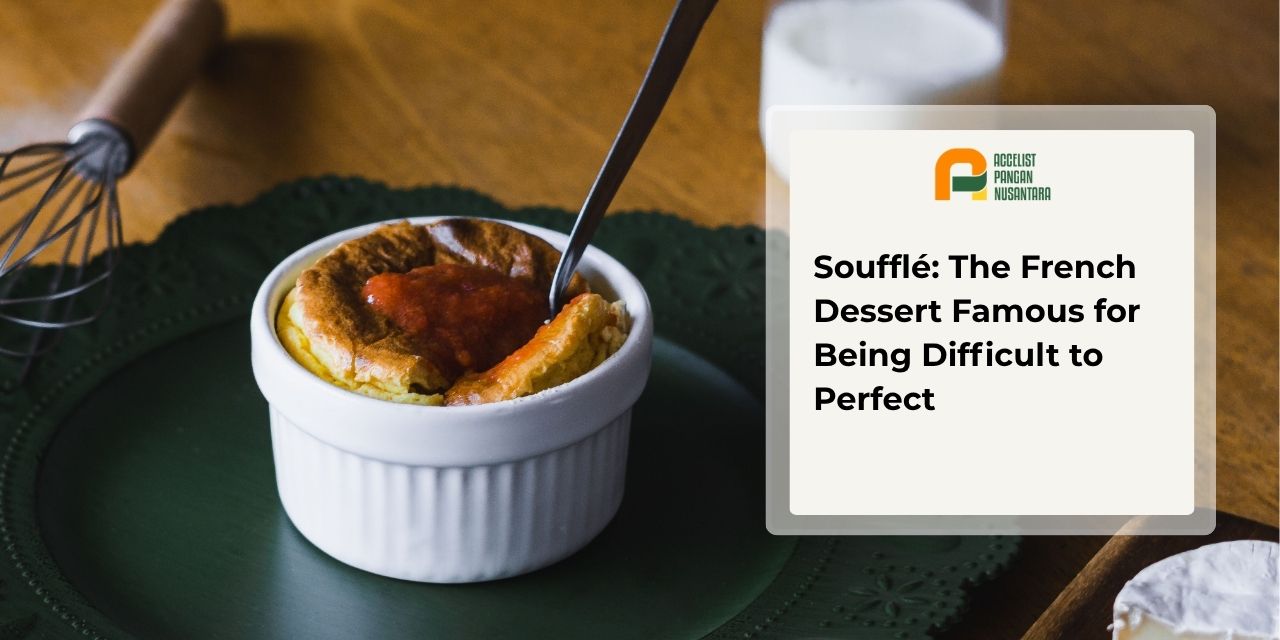
Soufflé is a French dessert that demands real precision despite its simple ingredients, and a single small mistake can drastically change the final result.
This article covers the history, varieties, and technical secrets behind soufflé’s texture, the same details that make so many people both curious and nervous about trying it themselves.
What Is a Soufflé?
A soufflé is a French dish made from a flavored base folded with whipped egg whites, then baked until it puffs up like a balloon. Once out of the oven, the surface slowly deflates within minutes, which is why a soufflé needs to be served and eaten while still hot.
The name soufflé comes from the French verb “souffler,” meaning to blow or to puff up. It describes how the batter rises as if inflated by air when it hits the oven’s heat, much like a balloon that has just been pumped full.
As a simple picture, imagine pouring batter three-quarters up a ramekin (a small heatproof ceramic dish typically used to bake individual soufflés), then watching the top rise a few centimeters above the rim after baking. That rising motion is exactly the “blowing” effect the name refers to.
The History of Soufflé: A Journey Through 18th-Century French Kitchens
According to Foodtech UKWMS, soufflé was not created by a single person but refined gradually by three French culinary figures over nearly a century. Each one added a different contribution, from the first written recipe to more modern baking techniques.
1. Vincent de la Chappelle, the Chef Who Coined the Name
The term soufflé was first recorded in the 1700s, introduced by French chef Vincent de la Chappelle. The first written soufflé recipe appeared in his book, “Le Cuisinier Moderne,” in 1742.
This early version was actually savory, made from potatoes rather than sweet ingredients as most people imagine today. The potato soufflé is the oldest known version and the starting point for every variation that followed.
2. Antoine Beauvilliers and the Birth of Cheese Soufflé
The recipe was later developed further by Antoine Beauvilliers, owner of the restaurant La Grande Taverne de Londres, which opened in 1782. He created a new version called “soufflé au fromage,” or cheese soufflé, with a technique described in his book “L’Art du Cuisinier” in 1814.
In that book, Beauvilliers explained that the still-hot soufflé base needed to be folded with whipped egg whites right away. That same principle is still used today, since the order and manner of mixing determines how high a soufflé can rise.
3. Marie-Antoine Carême and the Move to Modern Soufflé
The next key figure is Marie-Antoine Carême, a French chef who introduced more modern oven equipment for baking soufflés. He created a new variation called “soufflé rothschild,” filled with dried fruit, in the early 1820s.
Soufflé’s popularity spread widely through the recipes Carême published in his books. From there, soufflé evolved from a simple dish into an experimental one with countless flavor combinations, the same spirit still found in fine dining restaurants today.
Types of Soufflé You Should Know
Soufflés are generally grouped by flavor and how they are served, not treated as a single sweet dessert category. Understanding these categories helps you avoid confusion when ordering one or trying a recipe at home.
- Savory soufflé
This type is usually served as a starter or main course, made with ingredients like gruyère cheese, spinach, seafood, or fresh herbs. The most popular example is cheese soufflé, which has a slightly heavier texture because it contains bechamel sauce, butter, and milk. - Sweet soufflé
This type is more commonly served as a dessert, made with ingredients like chocolate, lemon, orange, vanilla, or aromatic liqueur. Chocolate soufflé is the most famous variation, typically served with crème anglaise or a berry sauce. - Cold soufflé
Unlike the two types above, cold soufflé is not baked and relies on gelatin for its chewy texture. It is often used for desserts prepared well ahead of time, since it does not need to be served straight from the oven.
Two Essential Components in Every Soufflé Batter
Regardless of flavor, every soufflé is built from two basic elements that work together. Without either component, the signature soufflé texture can never be achieved.
- The flavored base (crème pâtissière or a cream sauce)
This part serves as the flavor foundation, whatever type of soufflé is being made. For example, a melted cheese base for cheese soufflé, or a melted chocolate base for chocolate soufflé. - Stiffly whipped egg whites
This part creates the volume and light texture that rises during baking. This is clearest when egg whites are whipped to soft peaks, then gently folded into the base so the trapped air does not escape.
Why Soufflés Fail So Easily: The Technical Secrets
Soufflés most often fail due to a combination of technical factors, ranging from an oven that has not fully stabilized, to egg whites that were not folded correctly, to baking times that are off. Here is a breakdown of each factor and how to address it.
- Use room-temperature egg whites, since cold egg whites are harder to whip to full volume. As a rule of thumb, take the eggs out of the refrigerator about 30 minutes before whipping for a more stable, consistent result.
- Measure your ingredients precisely, because soufflé leaves no room for the rough estimates common in everyday home recipes. Even a small excess of liquid is enough to make the batter too heavy to rise properly.
- Make sure the oven is fully preheated before the batter goes in, since stable heat helps the air trapped in the egg whites expand evenly. In practice, preheat the oven for at least 10 minutes before the ramekins go in so the temperature is even throughout.
- Do not open the oven door while baking, as a sudden temperature change can cause the soufflé to collapse before it is fully cooked. The temptation to check early is one of the most common causes of failure, so patience is key.
- Grease the ramekins with butter and coat them with caster sugar so the soufflé rises smoothly without sticking to the sides. Baking time normally runs 10 to 15 minutes per ramekin, and the soufflé reaches its full rise within the first 5 to 10 minutes in the oven.
One more note, chocolate soufflé is known to be harder to make than cheese soufflé. Once out of the oven, chocolate soufflé tends to collapse faster, which is why many chefs add fruit or a sauce to help mask the deflation.
The Difference Between Soufflé and Mousse
Soufflé and mousse are often assumed to be the same thing since both are soft-textured French desserts. In reality, their preparation methods and serving temperatures are quite different, so it helps to understand the distinction before choosing which one fits your menu.
| Aspect | Soufflé | Mousse |
| Cooking technique | Baked in the oven until it rises | Mixed, then chilled in the refrigerator |
| Texture | Light and puffed, denser at the base | Creamy, soft like whipped foam |
| Serving temperature | Served warm, straight from the oven | Always served cold |
| Binding agent | Flour and egg yolk | Gelatin |
| Timing | Must be made just before serving | Can be prepared well in advance |
This fundamental difference means soufflé and mousse cannot simply substitute for one another, even though both come from French culinary tradition. Choosing between them should come down to how the dessert needs to be served, whether it calls for a warm, dramatic presentation or something practical that can be made ahead of time.
Interesting Facts About Soufflé You Might Not Know
Beyond the history and technique, there are a few lesser-known facts about soufflé worth mentioning. They make for interesting conversation starters and add a bit more depth to your culinary knowledge.
- Soufflé has earned the nickname “the delicate balloon.”
This nickname comes from how it puffs up dramatically, then slowly deflates once left to sit. This is easy to see in cooking videos, where a freshly baked soufflé visibly sinks within just a few minutes. - A successful soufflé is judged by two things at once
A soufflé is considered successful when it rises fully on the outside while staying soft and slightly molten inside. If the inside is too dry, the soufflé loses the very quality that makes it special. - The ramekin is not just an ordinary dish
This heatproof ceramic dish is chosen because it distributes heat evenly across the batter. Without the right ramekin, the soufflé’s surface can bake unevenly even at the correct oven temperature.
The Science Behind Soufflé’s Texture: Why Sinking Is Not the Same as Failing
Many people assume that a soufflé sinking right after it leaves the oven means the recipe failed. That assumption is not quite accurate, since the deflation is a natural consequence of the physical properties of egg white protein, not a sign of a technical mistake.
When whipped, egg white proteins such as ovalbumin and conalbumin denature and form a thin network that traps air bubbles. Oven heat then coagulates that network, temporarily hardening its structure enough to hold the soufflé upright the moment it is served.
As the temperature drops, that protein network loses some of its rigidity and the trapped air gradually escapes. Because of this, a soufflé shrinking within just a few minutes is actually proof that its structure formed correctly, not proof that the recipe failed.
Building on this principle, the most common beginner mistake is usually not an oven that is not hot enough, but a folding technique that is too rough, letting air escape from the egg whites before the batter even reaches the oven. Improving your folding technique has a bigger impact on how high a soufflé rises than simply raising the oven temperature, even though raising the oven temperature is the more common advice in popular recipes.
Conclusion
Soufflé proves that a dessert with simple ingredients can still demand real precision from anyone who attempts it. From Vincent de la Chappelle’s savory recipe in the 18th century to the sweet and cold variations we know today, one thing has never changed: whipped egg whites remain the key to that signature rising texture.
Whether for home kitchens or larger-scale bakery production, the consistency of whipped egg whites is what determines whether a soufflé rises perfectly or collapses along the way. This is exactly why many culinary businesses have started looking at alternatives that are more stable than fresh eggs.
If you want consistent soufflé results without depending on the variable quality of fresh eggs, Egg White Powder from Accelist Pangan Nusantara is worth considering. It is made from selected, high-protein egg whites, halal-certified, and Salmonella-free, supporting reliable batter structure for both home kitchens and industrial-scale bakery production.
For product details, stock availability, or a consultation on your culinary business’s ingredient needs, feel free to contact us.
FAQ
No, there are also savory soufflés such as cheese soufflé.
Because the air trapped inside the whipped egg whites shrinks as the temperature drops.
Soufflé is baked and served warm, while mousse is chilled and served cold.
No, chocolate soufflé is more fragile and collapses more easily than cheese soufflé.
Yes, egg white powder is a more stable alternative.