
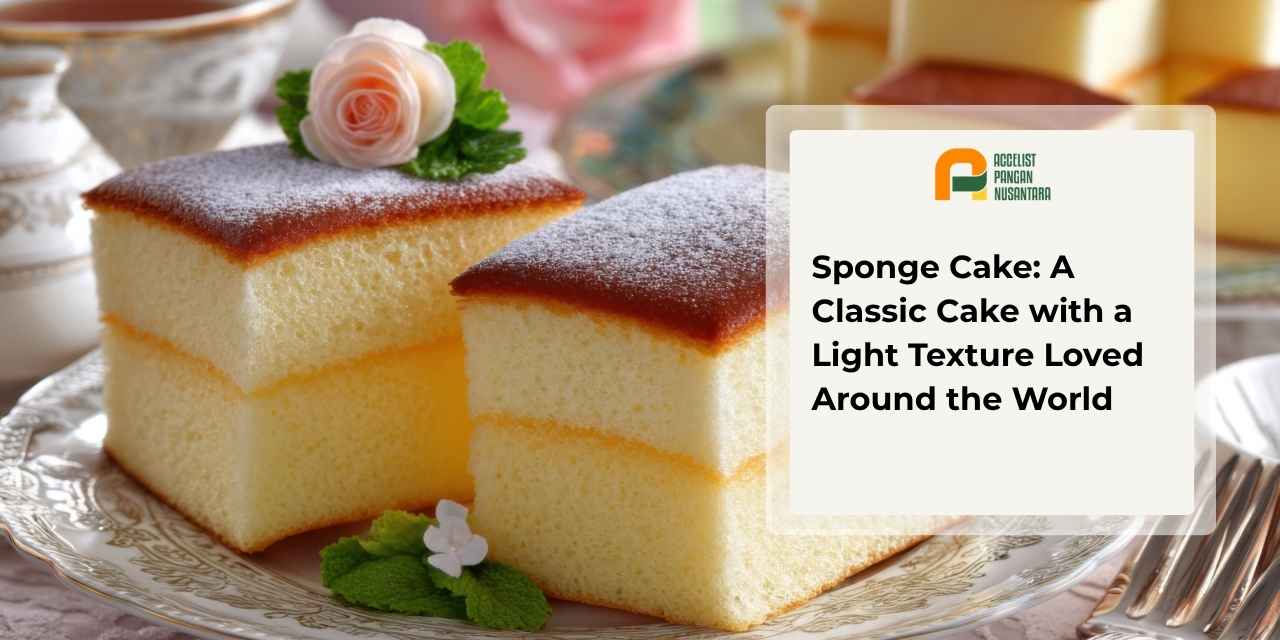
Imagine a birthday cake that’s been sliced open, revealing a light, airy, golden-yellow interior. That layer is almost always a sponge cake. This cake forms the base of nearly every layer cake, Swiss roll, and steamed sponge cake we encounter in our daily lives.
Sponge cake may sound simple. But it is precisely because of its simplicity that gaining a deep understanding of sponge cake is essential for anyone serious about bakery and pastry.
What is a sponge cake?
Sponge cake is a type of cake that falls under the category of foam cakes, which are cakes that use air incorporated from beating eggs as their primary leavening agent. Unlike butter-based cakes (butter cakes), sponge cakes use little or no added fat.
The basic ingredients are very minimal: eggs, sugar, and all-purpose flour. When processed with the right technique, these three ingredients produce a cake with a light texture, fine pores, and flexibility when rolled.
The key to its texture lies in the beaten eggs. When eggs are beaten, air becomes trapped within the albumen (the protein-rich white layer of the egg) and creates a stable foam structure. The air from the beaten eggs is the primary leavening agent for sponge cake, although some modern recipes also add baking powder to help maintain the cake’s volume.
Imagine whipping heavy cream until it forms stiff peaks. The principle is similar. It’s the trapped air that keeps the cream’s structure upright, just as the beaten eggs keep the sponge cake’s structure light and airy.
Read also: Brownies as a Popular Bakery Product in the Modern Food Industry
The History of Sponge Cake
Sponge cake is one of the oldest cakes ever recorded in Western culinary history. Its roots can be traced back to the Renaissance era, when Italian chefs began introducing yeast-free baking techniques to European kitchens, particularly in England and France.
The oldest written record of a sponge cake recipe in English is found in the book The English Huswife (1615) by Gervase Markham, an English poet and writer. The recipe in the book uses a mixture of flour, sugar, and eggs flavored with anise seeds and cumin, then beaten for nearly an hour using a bundle of twigs because metal whisks had not yet been invented. The result was not the soft cake we know today, but rather something more akin to a thin, crisp biscuit.
A major change didn’t occur until the mid-18th century, when bakers began to understand the importance of proper egg-beating techniques to allow the batter to rise higher. The next breakthrough came in 1843 when baking powder was invented by a British food manufacturer—an innovation that allowed sponge cake to rise more perfectly and achieve a texture far lighter than the original version.
In Indonesia, sponge cake is found in the form most familiar to our palates: bolu. Both steamed bolu and baked bolu are essentially local adaptations of sponge cake that have been tailored to local tastes and the availability of ingredients in the domestic market.
The Difference Between Sponge Cake and Other Cakes
Many people confuse sponge cake with chiffon cake or pound cake. However, the three are fundamentally different, from the type of fat used to the mixing method.
- Sponge cake is an egg-based cake made without added fat that relies on air as a natural leavening agent.
- Chiffon cake uses vegetable oil as the fat and separates the egg whites to be beaten separately, resulting in a lighter and moister texture.
- Pound cake is a cake made with a large amount of butter, producing a dense, rich texture with a crumbly crumb, typically baked in a loaf pan.
The following table summarizes the differences between the three.
| Aspect | Sponge Cake | Chiffon Cake | Pound Cake |
| Primary Fat Content | Fat-free or very low in fat | Vegetable oil | High butter content |
| Egg Preparation | Eggs are beaten whole or separated | Egg whites are whipped separately | Eggs are creamed with butter |
| Texture | Light, airy, fine crumb, slightly dry | Moist, airy, and tender | Dense, rich, and compact |
| Typical Applications | Layer cakes, Swiss rolls, sponge desserts | Served as a standalone cake | Loaf cakes and traditional butter cakes |
The table above shows that sponge cake is the “cleanest” in terms of ingredients because it does not rely on fat to create its texture. That is why the technique used to beat the eggs is the key to its success, not the amount of butter or oil in the recipe.
Types of Sponge Cakes You Should Know
The category of sponge cakes is actually quite broad. There are several variations, each with its own distinct characteristics and preparation methods, and understanding these differences is useful for anyone in the baking business.
- Classic Sponge (Génoise)
Génoise is an Italian and French-style sponge cake that uses the bain-marie method (heating eggs and sugar over boiling water while continuously whisking). The eggs are heated with the sugar until they reach maximum volume before the flour is added. The result is denser than a standard sponge, yet the flavor is richer and it often serves as the base for luxurious layer cakes in European pastries. - Chiffon Cake
Chiffon uses vegetable oil as the fat and separates the egg whites to be whipped to stiff peaks before being folded into the egg yolk batter. Its texture is moister than classic sponge due to the oil content, making it perfect to enjoy on its own without additional fillings or frosting. - Angel Food Cake
This type uses only egg whites, with no egg yolks and absolutely no butter. The result is a pure white cake with an extremely light texture. Angel food cake is baked in an ungreased pan, then inverted while cooling to prevent it from collapsing. - Swiss Roll (Rolled Sponge Cake)
A Swiss roll uses a sponge batter that is baked thinly in a flat pan, then rolled up with a filling of whipped cream, jam, or buttercream. This cake is believed to originate from Central Europe, such as Austria or Slovenia, and in the United States it is more commonly called a jelly roll because of its jelly-based filling. - Victoria Sponge
This popular British variation uses a small amount of butter in the batter, resulting in a slightly denser yet still light texture. The classic filling is strawberry jam and whipped cream. The name “Victoria” is associated with Queen Victoria, though the origin of the name itself lacks a single, definitive historical record.
Main Ingredients and Their Functions in Sponge Cake
Understanding the function of each ingredient is more than just theoretical knowledge. On a production scale, this understanding is what distinguishes a consistent product from one with unpredictable results.
Every ingredient in a sponge cake has a specific role that cannot be substituted arbitrarily. Here is an explanation.
1. Eggs
Eggs are the most important ingredient in sponge cake. They serve a dual function: providing structure through protein, while also adding volume through the air trapped during whisking. The egg yolk contributes a yellow color and a small amount of fat that enriches the texture, while the egg white produces a stable foam that acts as a natural leavening agent.
In production, the consistency of egg quality is a critical variable. The size, freshness, and temperature of the eggs all affect the final volume of the batter.
2. Sugar
Sugar is not merely a sweetener. Sugar helps stabilize the egg foam during beating, slows down coagulation (the process of protein solidification due to heat) so the cake has time to rise before its structure sets, and imparts a golden-brown color to the cake’s surface through the Maillard reaction (a chemical reaction between proteins and sugar when heated that produces the characteristic baked color and aroma).
3. All-Purpose Flour
Flour provides gluten (the protein network that forms the cake’s structure) and starch, which serves as the cake’s main structural component. Too much flour makes the sponge cake hard and dense, while too little causes it to deflate easily. Generally, sponge cakes use low-protein flour (soft flour) to maintain a light texture.
4. Baking Powder (Optional)
Some recipes include baking powder to aid in rising, especially if the egg-whisking process doesn’t produce enough volume. Its use is optional and is usually adjusted based on the baking method used.
Sponge Cake Making Techniques
The same ingredients can produce very different textures depending on the technique used. This is what makes making a sponge cake feel like a test for any baker.
There are two main methods for making sponge cake, and each has distinct characteristics.
1. All-in-One Method (Whole Eggs)
In this method, whole eggs are beaten with sugar until the mixture triples in volume and reaches the ribbon stage (the point at which the batter forms a ribbon-like stream when the spoon is lifted). The flour is then gently folded in using a spatula with a folding motion to prevent air from escaping.
The most common mistake at this stage is mixing the flour too vigorously or for too long. This results in a dense sponge cake that doesn’t rise.
2. Egg Foaming Method
This method separates the egg yolks and whites. The egg whites are beaten separately until stiff peaks form (the stage where the peaks stand upright and do not fall when the bowl is inverted), then gradually folded into the yolk mixture. This method generally produces a lighter texture and greater volume.
Chiffon cake and angel food cake use this egg-separating method. The result is a cake that feels much “fluffier” compared to génoise, which uses whole eggs.
Tips for Making a Perfect Sponge Cake Every Time
Sponge cake is a very process-sensitive dessert. Some small details that are often overlooked are actually the most common causes of failure.
- First, make sure all ingredients are at room temperature before you start mixing the batter. Cold eggs straight from the fridge produce less foam than room-temperature eggs because the proteins in cold eggs are stiffer and less flexible, making it harder for them to trap air.
- Second, do not open the oven during the first 15 to 20 minutes of baking. Sudden temperature changes break down the developing foam structure and cause the cake to sink in the middle.
- Third, remove the cake from the pan immediately and cool it on a wire rack once it’s done. A cake left in the pan for too long will sweat and become excessively moist on the bottom.
Whole Egg Powder: An Alternative to Whole Eggs in Sponge Cakes
Eggs are the cornerstone of sponge cakes. However, on an industrial scale, relying entirely on fresh eggs presents unique challenges that cannot be simply ignored.
The price of fresh eggs fluctuates with the seasons and market conditions. Additionally, storing fresh eggs requires specific temperatures, and their quality can deteriorate if the supply chain isn’t properly maintained. This is why some bakery producers are turning to egg powder mix as an alternative solution.
Whole Egg Powder is an egg-based product that has undergone a drying process (spray drying) to form a powder. The protein and fat content remains intact, so it generally functions in sponge cake batter as a substitute for whole eggs. To use it, simply dissolve it in water according to the recommended ratio before mixing it into the batter.
- Longer shelf life: Processed through modern drying methods that remove nearly all moisture, the product is far more durable than fresh eggs and does not require refrigerated storage.
- Consistent production quality: Unlike fresh eggs, whose size and quality can vary, egg powder mix delivers stable results in every production batch.
- Hygienic and free from contamination risks: A controlled production process ensures the product remains hygienic, including being free from the risk of Salmonella contamination commonly found in fresh eggs.
- Convenient and easy to measure: No need to crack the shells one by one. Simply dissolve in water according to the recommended ratio, then add directly to the batter.
- Nutritional profile preserved: The protein and essential nutrients in the eggs are preserved even after the drying process, so the nutritional value of the final product is not compromised.
Conclusion
Sponge cake is more than just a simple cake. It is the foundation of many pastry creations, from tiered layer cakes to elegant Swiss rolls, with a long history rooted in 17th-century European kitchens. Understanding how it works, its ingredients, and its preparation techniques provides a real advantage for anyone in the baking industry, whether on a home scale or in commercial production.
What makes sponge cake both challenging and fascinating is just how much the quality and consistency of the ingredients influence the final result. Solutions like egg flour mix address this need, particularly for producers seeking to maintain product quality without relying entirely on the variability of fresh eggs.
For more efficient sponge cake production, Accelist Pangan Nusantara’s Whole egg powder serves as a standardized substitute for whole eggs. Its formulation is designed to deliver performance comparable to fresh eggs in sponge cake batter.
With easier storage and more practical handling for production-scale use, Egg Flour Mix is the right choice for bakery businesses that prioritize consistency. Contact us for more information about the product and how to use it.
FAQ
Bolu is the local Indonesian term for sponge cake; both refer to the same cake.
Not necessarily. Egg-flour mix can be a more practical and consistent alternative, especially for large-scale production.
Usually because the eggs weren’t beaten long enough, the flour was mixed too vigorously, or the oven temperature was unstable.
Yes, by steaming it. Steamed bolu is a version of sponge cake cooked with steam.
It lasts 2 to 3 days at room temperature in a sealed container, or up to one week in the refrigerator.