
Picture a slice of lemon tart fresh out of the oven. The top is piled high with a soft, cloud-like layer of white, slightly browned at the edges, and melting the moment it touches your tongue.
Most people assume that white layer is part of the cake itself or just a fancy cream, when in fact it belongs to its own distinct category in the culinary world. That is what meringue is, and there is quite a lot worth knowing about it.
What Is Meringue?
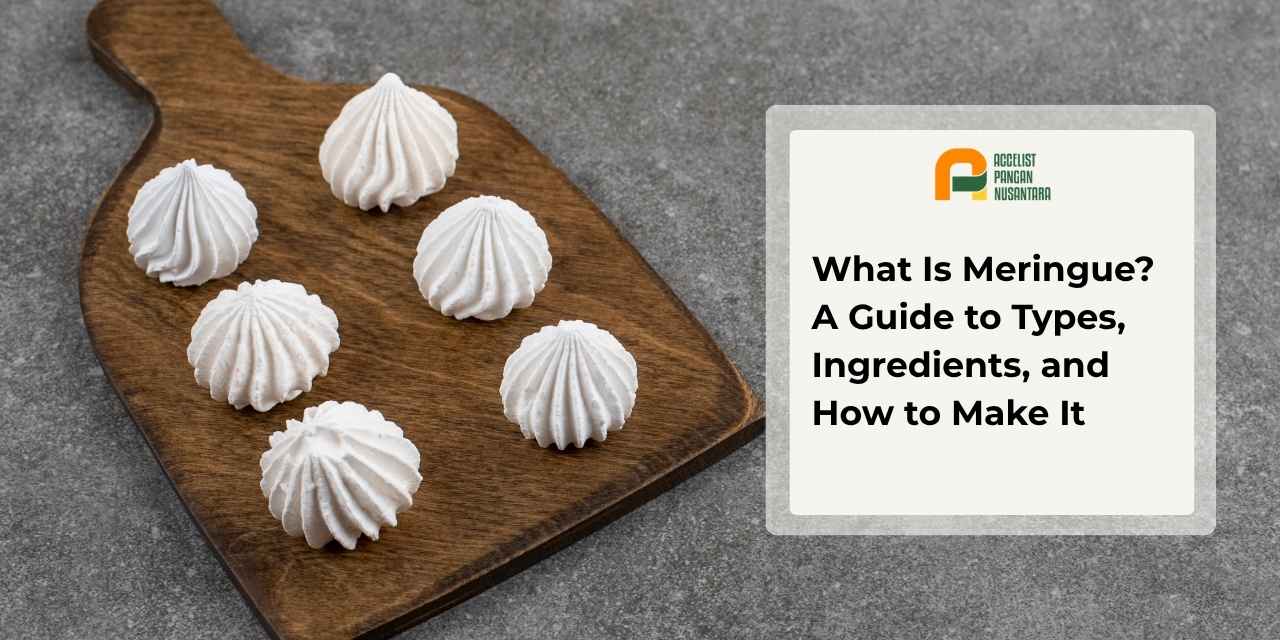
Meringue is a preparation made from egg whites and sugar whipped together until they form a light, stable foam. The mixture can be baked into a crisp confection, used as a topping for tarts, or serve as the base for a wide range of classic desserts.
Despite its appearance, meringue in the world of pastry sits closer to the category of “candy” than cake. There is no flour, no fat, and no leavening agent involved; its entire structure depends solely on the interaction between egg white protein and sugar.
According to Authentique French Bread, the origins of meringue are not documented in any single official record. The most widely cited theory holds that meringue was first created around the 18th century by an Italian pastry chef named Gasparini, who was living at the time in a small Swiss town called Meiringen.
The name of that town is widely believed to be the origin of the word “meringue” itself, though some accounts point to the German town of Mehrinyghen as an alternative theory. Regardless of which version is accurate, meringue has been part of European pastry tradition for centuries and is now recognized around the world.
Read also: Brownies as a Popular Bakery Product in the Modern Food Industry
Meringue Ingredients and How They Work
Meringue requires only two main ingredients to make. Behind that simplicity, however, is a fairly complex process that takes place when egg whites and sugar are whipped together to produce its characteristic texture.
1. Egg Whites
Egg whites are the primary component in making meringue because they are responsible for forming its structure and characteristic light texture. The protein content in egg whites enables the formation of foam that serves as the foundation of the meringue mixture.
When whipped, the proteins in egg whites, particularly ovalbumin (the most abundant protein found in egg whites), undergo structural changes and trap air as it enters during the whipping process. This produces a stable foam that allows meringue to rise properly and hold its shape.
2. Sugar
Sugar in meringue does more than add sweetness. It dissolves into the egg white liquid and reinforces the thin layer surrounding each air bubble, making the foam denser, more stable, and giving it that crisp texture once baked.
Meringue made with too little sugar will deflate easily and turn out soft. On the other hand, too much sugar causes the surface of the meringue to weep, because the excess sugar draws moisture from the surrounding air.
Types of Meringue
Meringue comes in several varieties distinguished by their preparation technique, not their base ingredients. Each type produces a different level of stability and texture, which is why their applications vary depending on the specific needs of pastry production.
1. French Meringue
French meringue is the simplest and most commonly made variety, where egg whites and sugar are whipped together without any heating until stiff peaks form. It is often used as a folded component in chiffon cake batter because of its light texture that blends easily into the main mixture.
Because no heat is involved, French meringue is the least stable of the three and its volume tends to drop more quickly. To help maintain its consistency, cream of tartar or a small amount of lemon juice is typically added to the mixture.
2. Swiss Meringue
Swiss meringue is made by first heating the egg whites and sugar together using the au bain-marie method, where the mixing bowl is placed over a pot of simmering water and stirred gently until the mixture reaches approximately 40°C to 55°C. Once the sugar has fully dissolved, the mixture is whipped with a mixer until it expands and holds stiff peaks.
This heating process makes Swiss meringue significantly more stable than French meringue, with a glossy, dense texture well suited for cake decoration. It can also be torched with a blow torch to achieve the characteristic browned finish commonly seen on top of lemon meringue tarts at pastry shops.
3. Italian Meringue
Italian meringue is the most structurally firm of the three, made by slowly pouring hot sugar syrup at around 115°C to 116°C into egg whites that are already being whipped at high speed. The heat from the syrup effectively cooks the egg whites on contact, making Italian meringue safe to consume without any additional baking.
This variety is the go-to choice for macaron fillings, meringue buttercream frosting, and desserts like Baked Alaska that require a meringue layer with high structural stability. In Baked Alaska, it is used as the outer coating that wraps the ice cream and can withstand a brief time in the oven without melting the ice cream inside.
Tips for Making Meringue Successfully
Meringue may look straightforward, but small mistakes can produce results that fall well short of expectations. There are a few technical points worth keeping in mind to get the texture right from the first attempt.
- Make sure all equipment is grease-free: Even a small trace of oil or egg yolk inside the bowl or whisk will prevent the egg whites from whipping up properly. Wipe the bowl with a paper towel dampened with vinegar or lemon juice before starting to ensure no fat residue remains.
- Use room-temperature egg whites: Cold egg whites contain proteins that are stiffer and harder to whip into a good foam. Take the eggs out of the refrigerator about 30 minutes before use.
- Add sugar gradually: Pouring all the sugar in at once from the start will slow down foam formation and result in a less stable meringue. Add the sugar little by little once the egg whites have begun to foam lightly.
- Bake at a low temperature for a long time: Meringue baked at too high a temperature will crack on the surface or brown before the inside has dried out. A temperature of 100°C to 110°C for one to two hours produces a more even, fully dried result.
Uses of Meringue in the Pastry World
Meringue is far more than a decorative element. In the pastry kitchen, it serves many roles, from contributing texture to acting as the outer shell for desserts that call for a dramatic visual finish.
Here are some of its most common applications.
- Pavlova is a meringue-based dessert baked with a crisp outer shell and a soft, marshmallow-like interior, typically served topped with fresh fruit and whipped cream.
- Macaron is a small French confection made from French meringue mixed with almond flour, sandwiched together with a cream or ganache filling.
- Lemon Meringue Tart is a tart with a lemon curd filling and a layer of Italian or Swiss meringue on top, lightly torched until golden.
- Dacquoise is a dry meringue layer mixed with almond or hazelnut, used as individual layers inside a layered cake.
- Baked Alaska is a show-stopping dessert consisting of ice cream encased in Italian meringue, then briefly placed in a hot oven until the surface is golden without melting the ice cream inside.
Egg White Powder as an Alternative to Fresh Egg Whites
Fresh egg whites are the traditional main ingredient for meringue because of their ability to form a stable foam. For production environments where consistency and efficiency are priorities, however, egg white powder can serve as a highly practical alternative.
Egg Powder is produced through a drying process that preserves the protein functionality of the egg whites. Once reconstituted with water, it can be used across a wide range of pastry applications, including meringue.
Benefits of Egg White Powder for Meringue Production:
- More consistent quality compared to fresh egg whites.
- No egg separation process required.
- Longer shelf life.
- Simplifies recipe standardization and production scaling.
- Reduces variability in raw ingredient quality.
- Still produces a stable foam suitable for meringue.
Egg White Powder from Accelist Pangan Nusantara can be used as a direct alternative to fresh egg whites for bakery and pastry production needs. Its use helps maintain consistent results while making the overall production process more efficient.
Read also: Bread Improver: Don’t Choose the Wrong One to Make Your Bread Rise Perfectly
Conclusion
Meringue is a pastry product built from just two simple ingredients, egg whites and sugar, yet the outcome varies widely depending on the technique applied. French, Swiss, and Italian meringue each carry their own characteristics, stability levels, and applications in the pastry world.
Understanding the differences between each type helps anyone choose the most suitable approach for their production needs. For those new to pastry, mastering French meringue first is a logical starting point before moving on to more complex techniques like Swiss or Italian.
To support consistency in large-scale production, Egg White Powder from Accelist Pangan Nusantara is available as a more practical ingredient alternative to fresh egg whites. It is formulated to deliver consistent results in meringue production, removing concerns about the quality variation that often comes with fresh eggs.
Interested in using Accelist Egg White Powder for your pastry production needs? Contact us and our team is ready to help you find the right ingredient solution for your business.
FAQ
Meringue contains no flour or fat, while sponge cake relies on both as core ingredients. Meringue’s structure depends entirely on egg whites and sugar alone.
The most common cause is residual fat or egg yolk inside the mixing bowl. Make sure all equipment is completely clean and dry before you start whipping.
Not necessarily. Italian meringue is already “cooked” by the hot sugar syrup, making it safe to eat without any additional baking.
Soft peaks mean the meringue has expanded but the tip still curls over, while stiff peaks mean the tip stands straight up and does not move even when the bowl is tilted.
Fully dried meringue will keep for up to two weeks when stored in an airtight container at room temperature, away from humidity.