

Requesting HACCP documents from a supplier is a step that often gets skipped, even though these documents are the real evidence that raw material production is genuinely under control. Without them, a buyer has no reliable way to confirm that food safety hazards have actually been identified and managed by the supplier.
Listeria and Salmonella together were responsible for 40% of all food and beverage recalls in the United States between 2002 and 2023, according to an analysis published in the Journal of Food Protection. A finding like that is a reminder that HACCP documentation is not a formality, but a real tool for catching risks that are not always visible on the surface.
This article covers the HACCP documents worth requesting from a supplier, from the types of documents involved to how to verify they are genuine. You will also find out how these records connect to controlling the raw material process behind products like egg powder.
How HACCP Connects to the Documents You Request From a Supplier
For a buyer, HACCP is the main reference for judging whether a supplier controls food safety hazards systematically, rather than relying only on end-product checks. HACCP documents are the written proof that a supplier genuinely applies this system, rather than simply claiming to. For a buyer, these documents become the basis for judging whether the raw material they are about to use has gone through adequate hazard control.
Read also: HACCP vs ISO 22000: The Key Differences Every Food Industry Professional Should Know
Why Ask for HACCP Documents Before Starting a Partnership?
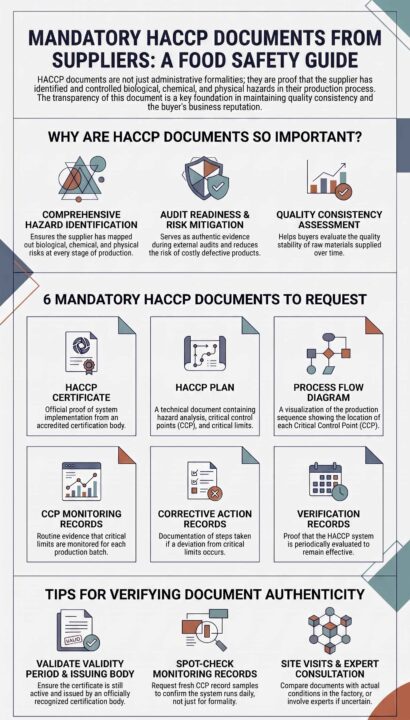
Requesting HACCP documents early in a partnership helps a buyer avoid risks that only become visible once the product is already in use. Here are four reasons this step is worth never skipping.
- Confirms the supplier has identified biological, chemical, and physical hazards at every stage of production
- Provides written evidence that can be shown again if an external audit takes place
- Helps the buyer assess raw material quality consistency over time
- Reduces the risk of defective or contaminated products that could damage the buyer’s business reputation
The HACCP Documents Worth Requesting From a Supplier
A complete set of HACCP documents covers more than just a certificate, since each principle in the system has its own supporting record. Here are six documents worth requesting from a supplier.
| Document | Function |
|---|---|
| HACCP certificate | Official proof from a certification body that the HACCP system has been implemented |
| HACCP plan | Covers the hazard analysis, critical control points, and critical limits at each production stage |
| Production process flow diagram | Shows where each critical control point sits within the production flow |
| CCP monitoring records | Evidence that critical control points are monitored routinely against set limits |
| Corrective action records | Documentation of the steps taken whenever a critical limit deviation is found |
| Verification records | Evidence that the HACCP system is periodically reviewed to stay effective |
These six documents complement each other and show that a HACCP system is not just paperwork, but a control tool that is actually carried out on the ground. The more complete the documents a supplier can produce, the more confidence a buyer can have in the consistency of the raw material they will receive.
How CCP Monitoring Records Connect to Denaturation Control in Egg Powder
One of the critical control points commonly found in egg powder production is the drying or pasteurization step, since its temperature and time determine both safety and final product quality. As a reference point, Canadian food safety regulation requires egg products to be heated to 63°C for 3.5 minutes to ensure Salmonella is fully destroyed, and this is the kind of parameter typically captured in CCP monitoring records.
The same heat used to destroy harmful bacteria is also what determines the level of protein denaturation in egg powder. If the temperature runs too high or the contact time is too long, the protein can denature excessively, reducing the foaming and emulsifying capacity of the final product.
This is why CCP monitoring records at the drying stage serve a dual purpose, standing as evidence of food safety while also acting as an indirect indicator of the functional quality of the resulting egg powder. A buyer who understands this can ask for specific temperature and time records, not just a general HACCP certificate.
Tips for Verifying a Supplier’s HACCP Documents
Not every HACCP document a supplier presents is genuinely valid or still current. Four steps below can help you verify their authenticity.
1. Check the Certificate’s Validity Period and Issuing Body
Make sure the HACCP certificate is still valid and was issued by an officially accredited certification body. A certificate that has expired or was issued by an unclear body deserves a closer look.
2. Ask for Recent Samples of CCP Monitoring Records
Ask the supplier to show CCP monitoring records from recent production batches, not just old documents kept for formality. Consistent, up-to-date records are a sign the HACCP system is genuinely running every day.
3. Conduct a Site Visit Whenever Possible
Compare the documents provided against the actual conditions at the production site through a direct visit. This step helps confirm the documents are not just drafted on paper without real implementation.
4. Consult a Food Safety Expert If You Are Unsure
Bring in a consultant or food safety expert to assess the completeness and validity of a supplier’s HACCP documents. This step is especially useful if the buyer does not yet have an internal team with deep knowledge of the HACCP system.
Conclusion
HACCP documents give a buyer real evidence that a supplier has controlled food safety hazards at every stage of production, not just an unsupported claim. From the certificate to the CCP monitoring records, each document plays its own role in building that confidence.
Understanding how CCP monitoring records connect to process controls such as protein denaturation helps a buyer assess raw material quality more thoroughly, not just from a food safety standpoint. Verifying the authenticity of these documents is the final step that should never be skipped before a partnership moves forward.
For culinary businesses or food manufacturers that need a raw material backed by complete HACCP documentation and a controlled production process, Egg Powder from Accelist Pangan Nusantara is produced with precise temperature monitoring to protect both safety and functional quality. Contact Us for product information and to discuss your business’s egg raw material needs.

FAQ
A HACCP certificate is official proof from a certification body, while a HACCP plan is the technical document that covers the hazard analysis and critical control points.
Not every supplier is legally required to, but suppliers who apply HACCP are generally more trustworthy because their hazard control is documented.
A CCP is a stage in the production process where control is genuinely necessary to prevent or reduce a hazard to a safe level.
These records show that control is carried out routinely on every production batch, not only at the point of initial certification.
Check the issue date and validity period on the certificate, and confirm it was issued by an officially accredited certification body.