
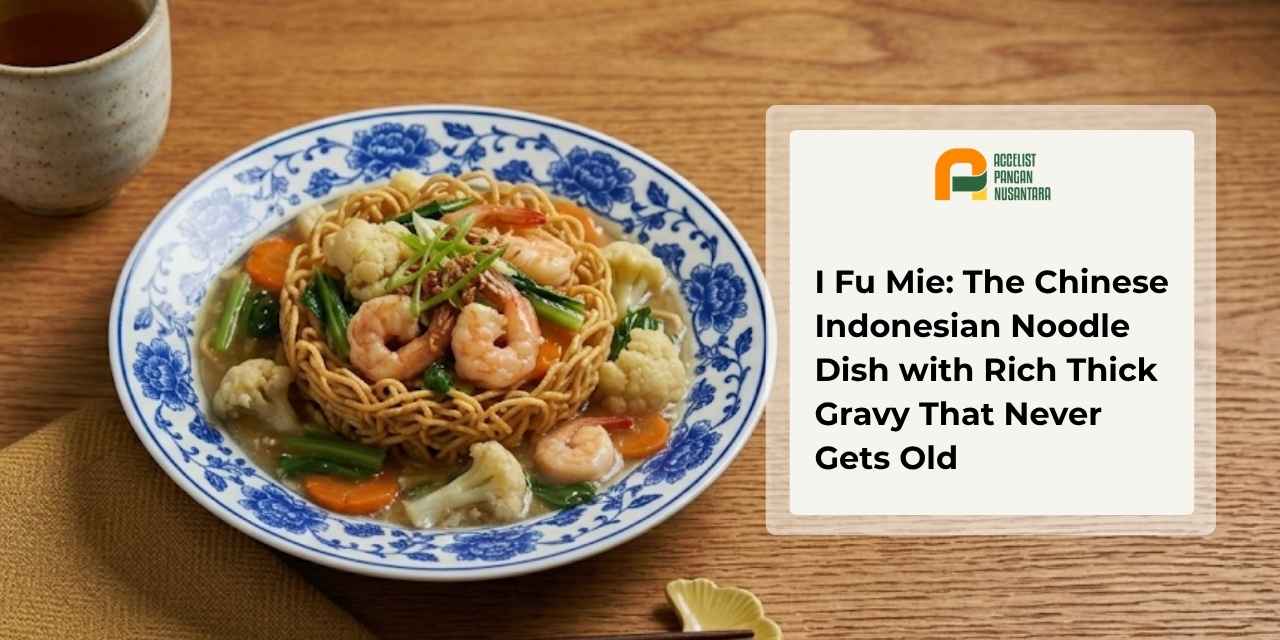
Chinese Indonesian cuisine is home to many iconic dishes that have become a staple of everyday dining, from bakmi and capcay to kwetiau and a wide variety of noodle dishes found in restaurants across the country. Among them, there is one dish that appears on almost every Chinese food restaurant menu, yet many people are unsure exactly what it is, where it comes from, or what sets it apart from other noodle dishes.
That dish is i fu mie, a Chinese Indonesian noodle specialty known for its golden fried egg noodles and rich, thick gravy.
What Is I Fu Mie?
I fu mie is a Chinese Indonesian egg noodle dish served in two distinct components: noodles that are deep-fried until golden brown, then topped with a thick, savory gravy filled with vegetables and a protein of choice such as chicken, shrimp, or meatballs. Also known as ifumie or ifumi, it stands as one of the most iconic dishes in the broader Chinese Indonesian culinary tradition.
According to Carry It Like Harry, the name “I Fu” comes from the type of noodle used, known as yi mein (伊麵), a Cantonese egg noodle historically associated with Qing Dynasty official Yi Bingshou (伊秉綬, 1754–1815), who is credited as the person who first popularized it.
Yi mein is made using an alkaline solution (lye water), which gives the noodle its signature golden hue and porous texture, allowing the gravy to slowly seep in when the dish is served.
I fu mie made its way to Indonesia through waves of Chinese migration from the regions of Canton (southern China) and Fujian (southeastern China) that arrived in the archipelago from the 19th century onward, bringing culinary traditions that gradually adapted to local tastes and ingredients. Cities such as Jakarta, Medan, Surabaya, and Semarang became hubs for Chinese Indonesian cuisine, and today i fu mie can be found in nearly every Chinese food restaurant across Indonesia.
Read also: Cwie Mie Malang: The Unique Noodle Dish That Defines Malang Cuisine
How I Fu Mie Differs from Other Noodle Dishes
Many people confuse i fu mie with regular fried noodles because both use noodles and various toppings. In fact, the two are quite different, in terms of cooking technique, the type of noodles used, and how they’re served.
| Aspect | I Fu Mie | Kwetiau Siram |
| Noodle type | Thick egg noodle (yi mein) | Flat rice noodle (kwetiau) |
| Origin | Cantonese Chinese cuisine | Cantonese Chinese cuisine |
| Cooking method | Noodles deep-fried separately; gravy cooked apart and poured over | Noodles stir-fried; thick gravy poured on top |
| Gravy | Thick, Chinese food-style with vegetables and protein | Thick, typically made with oyster sauce and egg |
| Noodle texture | Porous; slowly absorbs gravy over time | Flat and soft; does not absorb gravy the way yi mein does |
From the table above, it is clear that while all three dishes involve pouring a sauce over noodles, each has its own distinct character in terms of noodle type, origin, and flavor profile. I fu mie stands apart through its use of yi mein and its Chinese food-style thick gravy, elements that neither of the other two dishes shares.
Read also: Sweet and Egg Martabak: Which Is Healthier and Higher in Protein?
Ingredients for Making I Fu Mie
The ingredients for i fu mie fall into two main groups: the noodle ingredients and those for the thick gravy. Most of these are readily available at traditional markets or supermarkets.
Noodle Ingredients:
- Thick egg noodles (yi mein or similar)
- Cooking oil for frying
- Water for boiling
Gravy Ingredients:
- Protein of choice: chicken, shrimp, meatballs, squid, or mixed seafood
- Vegetables: carrot, cauliflower, bok choy, green mustard
- Seasonings: garlic, onion, soy sauce, oyster sauce, sesame oil
- Thickener: cornstarch dissolved in water
- Egg, whisked (for silky strands in the gravy)
- Chicken broth, salt, pepper, and sugar to taste
Tips for Cooking I Fu Mie
A few small details are often overlooked but make a significant difference in the final quality of i fu mie. Paying attention to these can be the difference between an average bowl and one that tastes like it came straight from a restaurant kitchen.
- Drain the noodles thoroughly before frying: Residual moisture from boiling will cause the oil to splatter and prevent the noodles from crisping evenly.
- Use enough oil for frying: Too little oil means the noodles will not be fully submerged, resulting in an uneven golden crust.
- Get the cornstarch ratio right: Gravy that is too thin will quickly soak through the noodles before they can be enjoyed. A common ratio is 2 tablespoons of cornstarch dissolved in 3 tablespoons of water for every 400 to 500 ml of gravy.
- Serve immediately after pouring the gravy: Waiting too long will cause the noodles to turn soggy throughout and lose their defining character.
Popular I Fu Mie Variations in Indonesia
I fu mie is not locked into a single formula or set of toppings. As Chinese Indonesian cuisine has evolved over the years, the dish has come in a range of variations tailored to local tastes and ingredient availability across different regions.
- Seafood I Fu Mie
This variation features a combination of shrimp, squid, and fish as the gravy’s protein, producing a stronger and more distinctive seafood flavor. A classic example is the Cantonese-style seafood i fu mie, which often includes scallops or clams for a more elevated, premium touch. - Chicken I Fu Mie
This is the most common variation and the easiest to prepare at home, as the main ingredient is widely available. Thinly sliced chicken breast or thigh fillet forms the base of the gravy, often paired with meatballs for added variety in texture. - Beef I Fu Mie
This variation uses thinly sliced beef as the primary protein, delivering a richer and more robust flavor. It is commonly served alongside broccoli and mushrooms, and can be found in Chinese food restaurants across most major Indonesian cities. - Vegetarian I Fu Mie
This version removes all animal protein, replacing it with mushrooms and tofu alongside a variety of vegetables as the gravy base. A vegetarian i fu mie made with oyster mushroom gravy and napa cabbage, for instance, delivers a naturally savory flavor that stands up well against its meat-based counterparts. - Mixed I Fu Mie
This variation brings together multiple types of protein in a single serving, such as chicken, shrimp, and meatballs all at once. It tends to be the go-to choice for diners who want to experience a wider range of flavors within a single bowl.
Read also: Mie Jebew: Indonesia’s Fiery Noodle Dish from Garut That Rivals Samyang
Conclusion
I fu mie is a living testament to the richness of Chinese Indonesian culinary heritage, a dish that has endured and evolved from its roots as Cantonese yi mein in the Qing Dynasty era to a beloved staple on restaurant menus across Indonesia. Its journey reflects the broader story of how Chinese culinary traditions adapted and found a lasting home in the archipelago.
What makes i fu mie consistently appealing is the combination of deep-fried egg noodles and a warm, thick savory gravy poured right at the moment of serving. Understanding its origins, ingredients, and variations allows us to appreciate this dish not just as food, but as a meaningful piece of cultural culinary history.
For food businesses that produce egg noodles on a large scale, the consistency of egg quality in the dough is a key factor in determining the final quality of the noodles. Accelist Pangan Nusantara’s Egg Flour offers a more practical and hygienic solution than fresh eggs, providing consistent quality in every production batch without the need to crack eggs one by one. For product information, industry consultation, or pricing quotes, Contact Us and the Accelist Pangan Nusantara team is ready to assist.
FAQ
No. Makassar dry noodles use thinner noodles with a lighter gravy, while i fu mie uses thick egg noodles with a denser, richer sauce.
Thick egg noodles such as yi mein, as their porous surface gradually absorbs the gravy without falling apart.
Yes, though the result will differ from the traditional version. Use unflavored instant noodles so the taste of the homemade gravy is not overpowered.
Store the noodles and gravy separately in airtight containers in the refrigerator, then reheat the gravy and pour it over the noodles when ready to serve.
The gravy keeps for up to 2 days in the refrigerator, while the fried noodles are best consumed on the same day.