
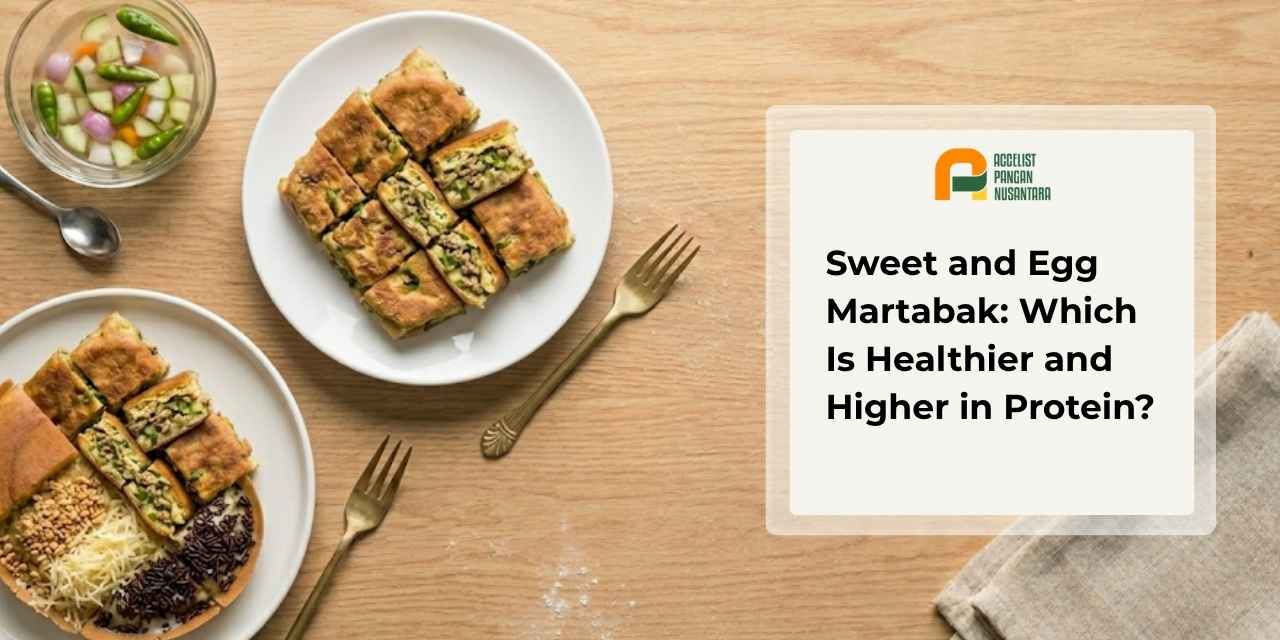
Every evening, street stalls and food trucks selling martabak are almost always crowded with customers coming and going. At a single stall, there are usually two main options available: sweet martabak topped with chocolate and cheese, or savory egg martabak filled with seasoned minced meat that feels more filling.
Interestingly, sweet martabak and egg martabak do not actually come from the same culinary tradition, even though they are sold side by side and share the same name. Understanding the difference between the two offers a deeper look into Indonesia’s rich and diverse food history.
Getting to Know Sweet and Egg Martabak
Before diving into a more technical comparison, it is important to understand the basic profile of each type of martabak. Both have very different characteristics, from texture and flavor to preparation methods.
Sweet Martabak
Sweet martabak is a thick pancake made from wheat flour, eggs, sugar, and leavening agents. It is cooked in a deep cast-iron pan until the inside becomes soft and full of tiny air pockets. Once cooked, the surface is topped with ingredients such as butter, sugar, peanuts, chocolate, or cheese before being folded in half and served.
Its signature porous texture comes from the reaction of baking soda or yeast when exposed to heat, creating small holes throughout the pancake. A good sweet martabak should feel soft and fluffy on the inside while slightly crispy around the edges, especially when served warm.
Egg Martabak
Egg martabak is made from thin dough stretched until elastic, then filled with beaten eggs, minced beef or lamb, scallions, and spices such as pepper and curry powder. After the filling is added, the dough is folded and fried on a flat pan with oil until golden brown.
What makes it different from other fried pastries is its crispy outer layer combined with a moist and savory filling, as the egg and meat juices seep into the dough during cooking. A good egg martabak usually feels dense and hearty, very different from the lighter impression of sweet martabak.
Read also: Tofu Martabak (Martabak Tahu)
The History and Origins of Martabak in Indonesia
Martabak has become one of Indonesia’s most popular nighttime street foods, enjoyed by people from all backgrounds. Although both are called martabak, sweet martabak and egg martabak actually have different histories, cultural influences, and origins. Interestingly, both are products of foreign culinary traditions adapted to Indonesian tastes.
The History of Sweet Martabak
According to DAAI TV Indonesia, egg martabak was heavily influenced by an Indian dish called “Moortaba.” The dish was reportedly introduced by an Indian man named Abdullah bin Hasan al-Malibary to Ahmad bin Abdul Karim in Semarang around the 1930s. After being adapted to suit local Javanese tastes, egg martabak eventually became the savory street food widely known across Indonesia today.
As it spread throughout Indonesia, sweet martabak became known by different names in different regions, such as terang bulan, kue Bandung, and apam pinang. Today, modern variations feature toppings like chocolate, cheese, matcha, and even red velvet, making it increasingly popular among younger consumers.
The History of Egg Martabak
Egg martabak has strong influences from an Indian dish called “Moortaba.” According to historical accounts, it was introduced by an Indian man named Abdullah bin Hasan al-Malibary to Ahmad bin Abdul Karim in Semarang around the 1930s. After being adapted to suit Javanese tastes, egg martabak became the popular savory dish known today.
Initially, egg martabak developed in Lebaksiu, Tegal, Central Java, before spreading to many Indonesian cities through traveling night market vendors. The word “martabak” itself is believed to come from the Arabic word “mutabbaq,” meaning “folded,” referring to the way the dough is folded during cooking.
Differences in Ingredients and Cooking Methods
From a kitchen perspective, the differences between sweet martabak and egg martabak can already be seen during ingredient preparation. Both require different techniques and produce entirely different final products.
Main Ingredients of Sweet Martabak
Sweet martabak batter consists of wheat flour, eggs, sugar, milk, yeast or baking soda, and a pinch of salt. All ingredients are mixed into a liquid batter, then poured into a hot cast-iron mold and left to rise until airy and porous.
The process is relatively simple and does not require advanced skills. The most important factors are the pan temperature and cooking timing to prevent the inside from collapsing after removal from heat.
Main Ingredients of Egg Martabak
Egg martabak consists of two separately prepared components: the dough and the filling. The dough is made from wheat flour, water, and oil kneaded until elastic, while the filling contains two to three beaten eggs, minced meat, scallions, and spices.
Stretching the dough manually is a skill that requires practice and cannot be mastered overnight. Dough that is too thick becomes tough, while dough that is too thin can easily tear during folding.
Read also: 7 Ways to Choose Fresh Eggs Without Making Mistakes
Nutritional Comparison Between Sweet and Egg Martabak
Beyond taste and Beyond taste and history, sweet martabak and egg martabak also differ significantly in their nutritional profiles. The following comparison is based on data from FatSecret Indonesia, the differences between sweet martabak and egg martabak are also visible in their nutritional profiles.
| Nutrient | Egg Martabak (110 g) | Sweet Martabak (90 g) |
| Calories | 203 kcal | Sweet Martabak (90 g) |
| Carbohydrates | 20.38 g | 37.37 g |
| Protein | 10.89 g | 7.01 g |
| Fat | 8.45 g | 11.31 g |
Values may vary depending on recipe, ingredients, and serving size.
Based on the table above, egg martabak contains more protein while being lower in calories, carbohydrates, and fat compared to sweet martabak. Sweet martabak, meanwhile, tends to be higher in energy density because of its sugar, butter, and topping content.
Read also: Fried Egg Calories: Complete Guide to Nutrition Facts and Healthy Eating Tips
Things to Consider Before Eating Sweet or Egg Martabak
Knowing the nutritional content alone is not enough without understanding the right way and conditions to consume these foods. There are several important considerations, especially for people with certain health conditions.
For individuals with prediabetes or those trying to control blood sugar levels, sweet martabak should be consumed carefully. Its high carbohydrate content, reaching over 37 grams per serving, may significantly increase blood sugar when eaten excessively.
Egg martabak also comes with considerations. The fat content from eggs, minced meat, and frying oil may be problematic for people monitoring cholesterol levels or those with a history of heart disease, especially if consumed frequently.
Since both types are commonly eaten at night, portion control is important. Consuming high-calorie and high-fat foods close to bedtime may slow digestion and increase excess calorie intake. A reasonable portion is around two to three pieces for egg martabak and one to two pieces for sweet martabak.
Pairing martabak with cucumber pickles or fresh vegetables can also help increase fiber intake while balancing the richness of fried foods. Ultimately, the key is moderation rather than complete avoidance.
Egg Powder as an Alternative to Fresh Eggs in Martabak Production
In both sweet and egg martabak production, eggs play an important role in texture, flavor, and overall product quality. However, large-scale food production often faces challenges with fresh eggs, including inconsistent sizing, limited shelf life, and fluctuating quality.
As a more practical alternative, Accelist Pangan Nusantara offers egg powder products processed hygienically using spray drying technology. This process converts liquid eggs into fine powder by spraying them into a high-temperature chamber, reducing moisture while preserving essential nutrients.
Available product variants include:
- Egg White Powder: Suitable for recipes requiring light and airy textures.
- Egg Yolk Powder: Provides natural color, savory flavor, and richer healthy fat content.
- Whole Egg Powder: A practical combination of egg whites and yolks for various food applications.
- Salted Egg Powder: Delivers the distinctive savory flavor of salted eggs, ideal for creative martabak fillings or toppings.
With more stable quality and longer shelf life compared to fresh eggs, egg powder products can become an efficient solution for consistent martabak production and other egg-based culinary products.
Read also: Here’s the Difference Between Egg Types Based on Animal Species and Farming Methods
Conclusion
Sweet martabak and egg martabak are two completely different culinary creations, despite always appearing side by side at the same street stalls every night. From their origins, ingredients, cooking techniques, to nutritional profiles, both have traveled very different historical paths before sharing the same name.
Choosing between them is not about deciding which one is absolutely better, but rather about personal preference and nutritional needs, whether for a sweet and indulgent treat or a more protein-rich savory meal. Both deserve appreciation as part of Indonesia’s evolving culinary heritage.
For culinary businesses producing egg martabak on a large scale, maintaining consistent egg quality is essential to ensuring flavor consistency and customer satisfaction. Accelist Pangan Nusantara provides high-quality egg powder products designed to support consistent egg-based food production, from small businesses to industrial-scale operations. Contact us for more product information and further consultation.
FAQ
No. Egg martabak was influenced by Arab and Indian culinary traditions, while sweet martabak developed from the culinary culture of the Hakka Chinese community in Bangka Belitung.
Based on data from FatSecret Indonesia, egg martabak contains fewer calories, carbohydrates, and fat, while providing more protein per serving compared to sweet martabak.
Most likely because both types have long been sold side by side at the same street food stalls, leading people to commonly refer to them under the same generic name.
A typical serving usually contains two to three eggs, which serve as the primary source of protein in egg martabak.
In sweet martabak, flour is mixed into a liquid batter that rises during cooking, while in egg martabak, the flour is kneaded into an elastic dough used to create a thin outer wrapper.