
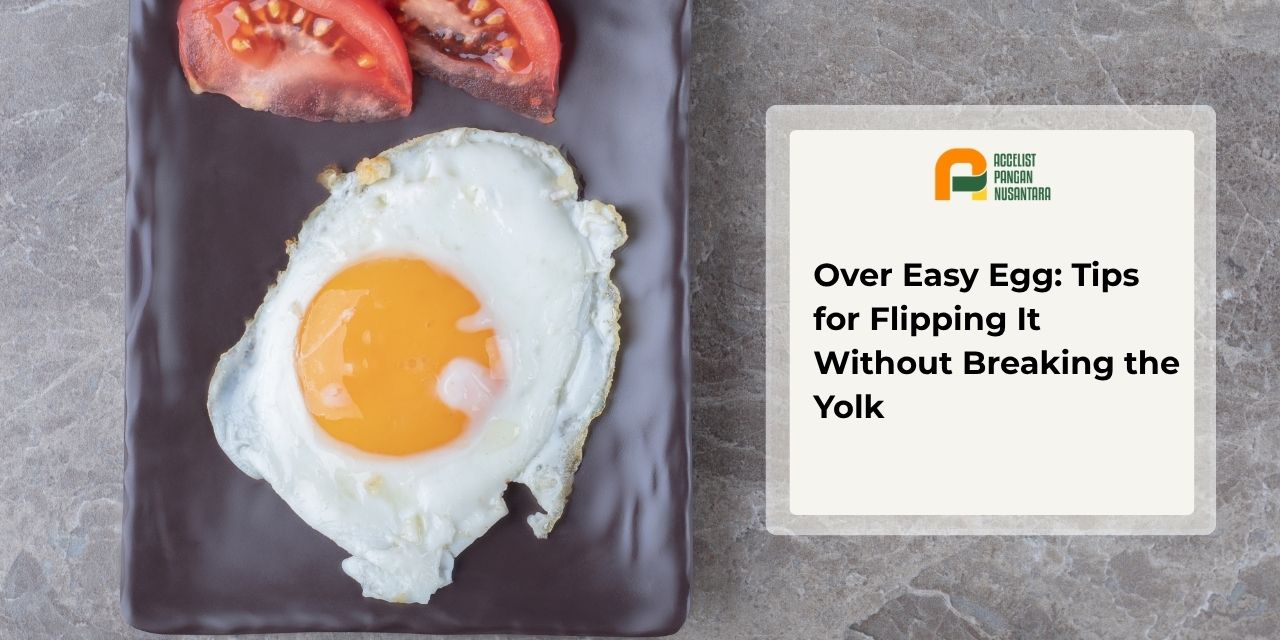
An over easy egg is a fried egg that gets flipped briefly on its second side, so the yolk stays soft while the whole thing holds together neatly on the plate. It sounds simple, but the result often falls short the moment people try it themselves at home.
Indonesia’s National Food Agency chief, Andi Amran Sulaiman, has cited data from Statistics Indonesia (BPS) showing that average egg consumption in Indonesia reached 2.362 kilograms per capita per week in 2025. That figure reflects just how much of a daily staple eggs have become, both in home kitchens and in food businesses.
It makes sense, then, that people keep searching for a fried-egg technique that is both practical and tidy, like the over easy method. Unfortunately, that is exactly where small mistakes tend to creep in.
What Is an Over Easy Egg, and How Is It Different from Sunny Side Up?
The key difference comes down to flipping: an over easy egg gets flipped once in the pan, while a sunny side up egg is never flipped at all. That single step changes how done the white and yolk end up, as explained below.
Over Easy Egg
An over easy egg is fried on one side until the white starts to set, then flipped and cooked briefly on the other side. That flip is what leaves the yolk lightly set on the outside while staying runny underneath.
Picture it on a burger or a sandwich: the yolk thickens just slightly from the brief heat on both sides. That makes it far less messy to bite into than an egg fried on only one side.
Sunny Side Up
A sunny side up egg is fried on one side only and never flipped. The white sets on the bottom while the yolk stays completely runny, since it only ever faces heat from one direction.
You can see this in a plate of fried rice topped with a whole fried egg. The yolk is left fully intact on purpose, meant to break open only once it hits the rice.
Beyond these two, there are also over medium and over hard eggs, which belong to the same flipped-egg family as over easy but differ in how long the second side cooks. The table below sums up the differences.
| Style | Flipped? | Yolk Condition | Second-Side Time |
|---|---|---|---|
| Sunny side up | No | Fully runny | None |
| Over easy | Yes, once | Runny, thin set outer layer | 15-30 seconds |
| Over medium | Yes, once | Half runny, slightly thick | 45-60 seconds |
| Over hard | Yes, once | Fully set, no runniness | 1.5-2 minutes |
Common Mistakes That Ruin an Over Easy Egg
Four mistakes come up most often heat that’s too high, flipping too soon, a spatula that’s too narrow, and eggs used straight out of the fridge. Plenty of people already understand the concept in theory, but only realize what’s going wrong once they see it laid out below.
- Heat set too high. High heat scorches the bottom of the white before the top has a chance to set. An egg fried over high heat, for instance, usually ends up with dark brown edges while the center is still runny.
- Flipping too soon. A white that hasn’t fully set yet tears easily when a spatula touches it. Once that happens, the yolk breaks and mixes right into the white.
- Using a spatula that’s too narrow. A small spatula can’t lift the whole egg cleanly, so the edges get left behind or fold over during the flip. A wide, flat spatula is a much safer choice for this technique.
- Starting with a cold egg. An egg straight from the fridge cooks unevenly between the outside and inside. Letting it sit at room temperature for a few minutes first helps it cook more evenly.
6 Steps to a Perfect Over Easy Egg
A perfect over easy egg starts with heating the pan over medium-low heat (roughly 130-150°C, or once the oil just begins to ripple faintly), and ends with a single quick flip followed by a brief finish on the second side. Here is the full breakdown to keep the yolk intact from start to plate.
- Heat a non-stick pan with a little oil or butter, over medium-low heat.
- Crack the egg into a small bowl first, rather than straight into the pan, so no shell fragments end up in the egg.
- Pour the egg gently into the hot pan, then leave it undisturbed until the white starts to set on the bottom.
- Sprinkle in a little salt, then gently shake the pan to make sure the egg isn’t sticking.
- Flip the egg in one confident motion with a wide spatula, once the edges of the white are no longer translucent.
- Cook the second side for 30 seconds to a minute, then move it straight to the plate while the yolk still feels soft to the touch.
Why Egg Quality Determines the Outcome of an Over Easy Egg
Egg quality shapes the final result because freshness affects how thick the white is once it hits the pan. A fresher egg has a thicker white that gathers neatly around the yolk, while an older egg tends to be thinner and spreads out across the whole pan.
Flipping an egg without breaking the yolk takes practice, but it’s far from impossible to learn. Once the timing, heat, and spatula motion become second nature, an over easy egg turns into a go-to dish you can serve anytime without second-guessing yourself.
For food businesses, keeping egg results consistent day after day is a bigger challenge than cooking for family at home. Variation in fresh egg quality across different suppliers can make the finished dish inconsistent, even though customers expect the same taste and appearance with every order.
Accelist Pangan Nusantara offers a wide variety of egg powders, one of which is Whole Egg Powder, a solution for businesses that need processed eggs of consistent quality that are easy to store and remain hygienic, without relying on a daily supply of fresh eggs. Contact us to learn more about how Egg Powder Mix can be tailored to the needs of your commercial kitchen.
FAQ
s, as long as the egg is fresh and the white is cooked all the way through.
About two to three minutes for both sides combined, depending on egg size and pan heat.
No, because the white is always fully cooked and only the yolk is left soft.