
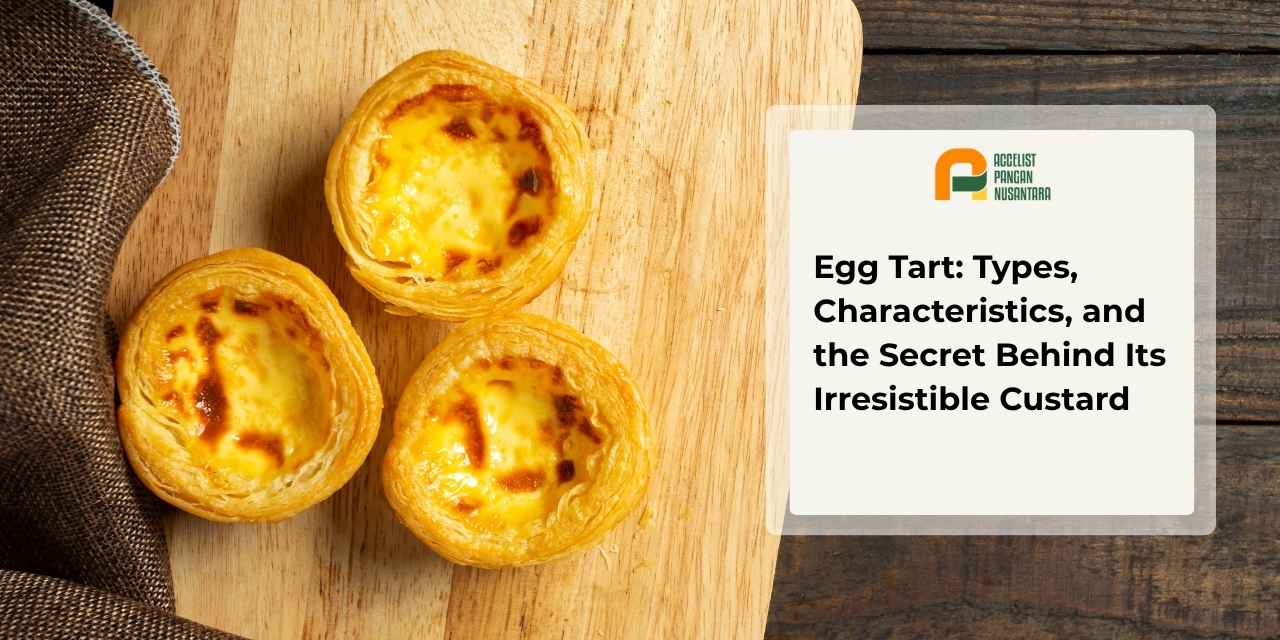
Picture a café display case filled with small, golden-yellow pastries, almost always sold out before lunchtime hits. Just a faint caramel aroma from the surface is enough to make people stop and order a whole box.
Demand for pastries like this is partly driven by the growth of Indonesia’s bakery market, which 6Wresearch projects to grow nearly 9.4 percent a year through 2029. Small shops selling custard-filled pastries keep popping up in more and more cities.
One consistent favorite among buyers is the egg tart, a bite-sized pastry with a soft egg custard filling tucked inside a crisp crust.
What Is an Egg Tart?
An egg tart is a small tart with a thin pastry shell filled with sweet egg custard. It is usually served warm alongside tea or coffee, found both in dim sum restaurants and modern cafés.
The name itself points to the filling’s main ingredient, a mix of eggs, sugar, and milk or cream baked until softly set. In some countries, the pastry goes by a local name, such as daan tat in Hong Kong or pastel de nata in Portugal.
The History of Egg Tart Across Three Continents
Egg tart is often assumed to be a Hong Kong invention, but its roots run much deeper and span several countries. Here are a few key milestones in its journey, from a European monastery kitchen to today’s café counters.
- Before the 18th century, Lisbon, Portugal
According to Pearl River Mart, monks at the Jerónimos Monastery made pastel de nata from leftover egg yolks, after the whites had been used to stiffen or starch the monks’ habits before ironing. - 1920s, Canton (present-day Guangzhou)
South China Morning Post notes that the British introduced the custard tart to the city of Canton, where Chinese chefs adapted it using their dim sum pastry techniques. - After World War II, Hong Kong
Pearl River Mart notes that cha chaan teng diners began appearing across Hong Kong around this time, serving Western-style dishes with a Chinese touch, egg tart included. - 1989, Coloane, Macau
Andrew Stow, a British pharmacist, opened Lord Stow’s Bakery and developed a Macau take on the Portuguese egg tart with an English-style custard twist, rather than simply copying the original pastel de nata.
This hybrid version created by Andrew Stow is what most people abroad, including in Indonesia, now recognize as the “Portuguese egg tart.” Hong Kong’s daan tat, meanwhile, is actually closer kin to the English custard tart than to Portugal’s pastel de nata.
Getting to Know the Popular Types of Egg Tart
The egg tart sold today is not really a single recipe. Each country has added its own twist, resulting in several variants with noticeably different crusts and fillings.
1. Portuguese Egg Tart (Pastel de Nata)
This version uses a layered, flaky puff pastry shell filled with egg custard that is baked until the surface turns lightly charred and caramel-brown. That thin caramelized layer is its most recognizable trait.
Pastéis de Belém, a legendary shop in Lisbon that has been operating since 1837, is said to still use the original recipe from the Jerónimos Monastery to this day.
2. Hong Kong Egg Tart
Unlike the Portuguese version, Hong Kong egg tart typically uses a thicker, denser shortcrust shell. Its custard surface stays smooth and bright yellow, with no caramelization at all.
When you buy an egg tart at a dim sum shop, the surface is usually completely flat, quite different from the caramel-brown speckles on a Portuguese egg tart.
3. English Egg Custard Tart
The English egg tart is the ancestor of many other versions found around the world, built on a shortcrust base with a filling of eggs, cream, sugar, and a touch of nutmeg. Its texture tends to be denser than the Hong Kong or Portuguese versions.
That hint of nutmeg is exactly what makes a bite of English egg custard tart taste distinct from its Asian cousins, even though they look fairly similar.
4. Pie Susu
In Indonesia, egg tart has its own local version known as pie susu, popular as a souvenir from Bali. Its filling is made from eggs, sweetened condensed milk, and cornstarch, set inside a simpler shortcrust shell.
When visiting Bali, pie susu is almost always sold in small boxes at souvenir shops along the road to the airport.
How Portuguese Egg Tart Differs From Pie Susu, Despite Looking Alike
Because they both have a yellow custard filling and a round shape, Portuguese egg tart and pie susu are often mistaken for the same pastry. Look closer, though, and the differences add up, from the crust to the price tag.
| Aspect | Portuguese Egg Tart | Pie Susu |
| Crust type | Layered, flaky puff pastry | Dense shortcrust, no layers |
| Filling surface | Caramel-brown from caramelization | Even yellow, no caramelization |
| Average size | About 5 to 7 cm in diameter | About 10 to 12 cm in diameter, flatter |
| Production process | Complex, requires repeated dough folding | Simpler, just mixed and molded |
This difference in process is felt directly in the kitchen. A bakery selling Portuguese egg tart needs more time, since the puff pastry has to be chilled and folded repeatedly, while pie susu can be molded and baked in a much shorter time.
The Key to Smooth, Bubble-Free Egg Tart Custard
Many people fail to make egg tart with smooth custard, even though the recipe itself usually isn’t the problem. Why?
Often it is just a few small details in handling the custard that get overlooked. Here is what determines whether egg tart custard turns out neat or full of holes.
- Strain the custard batter before pouring it in, to remove any undissolved bits of egg or sugar.
- Let the custard batter rest for about one to one and a half hours, so the air bubbles formed while mixing have time to rise and disappear.
- Keep the oven temperature from running too high, since custard baked at too high a heat will puff up first, then deflate and wrinkle once it comes out.
- Make sure the tart shell has cooled completely before pouring in the custard, so the edges don’t set before the center finishes cooking.
- Use eggs of consistent quality and size, since differences in water and fat content between eggs directly affect how thick the custard turns out.
Conclusion
From a monastery in Portugal to today’s trendy café counters, egg tart has proven it can cross cultures for nearly three centuries. Each country has added its own signature touch, yet the heart of this pastry stays the same, soft egg custard inside a crisp pastry shell.
When it comes to taste, no single type of egg tart is objectively the best, since Portuguese egg tart, Hong Kong egg tart, and pie susu each suit different preferences and occasions. What usually separates a successful egg tart product in the market isn’t the recipe, but how consistent the custard’s texture and color stay from one batch to the next.
For bakery businesses that want to keep their custard color consistent without relying on a fluctuating supply of fresh eggs, Egg Yolk Powder from Accelist Pangan Nusantara can be a practical solution for producing egg tart at a larger scale. Interested in learning more about its specifications and how to use it for your production line? Contact Us for further consultation.
FAQ
Egg tart is a type of custard tart, distinguished by its egg-forward filling. Custard tart is the broader term for any tart filled with custard, including the English version.
Hong Kong egg tart bakes at a carefully controlled temperature so the custard sets evenly without caramelizing. Portuguese egg tart bakes at a high temperature until caramel-brown spots appear on top.
Pie susu belongs to the egg tart family, since both use an egg-and-milk custard filling. The difference lies in the filling ingredients and its distinctly Indonesian look.
Egg tart tastes best within a few hours of coming out of the oven. Stored tightly sealed in the fridge, it usually stays good for up to 4 days.
The main cause is air bubbles left in the batter during baking. Straining and resting the batter before baking is usually enough to fix this.