
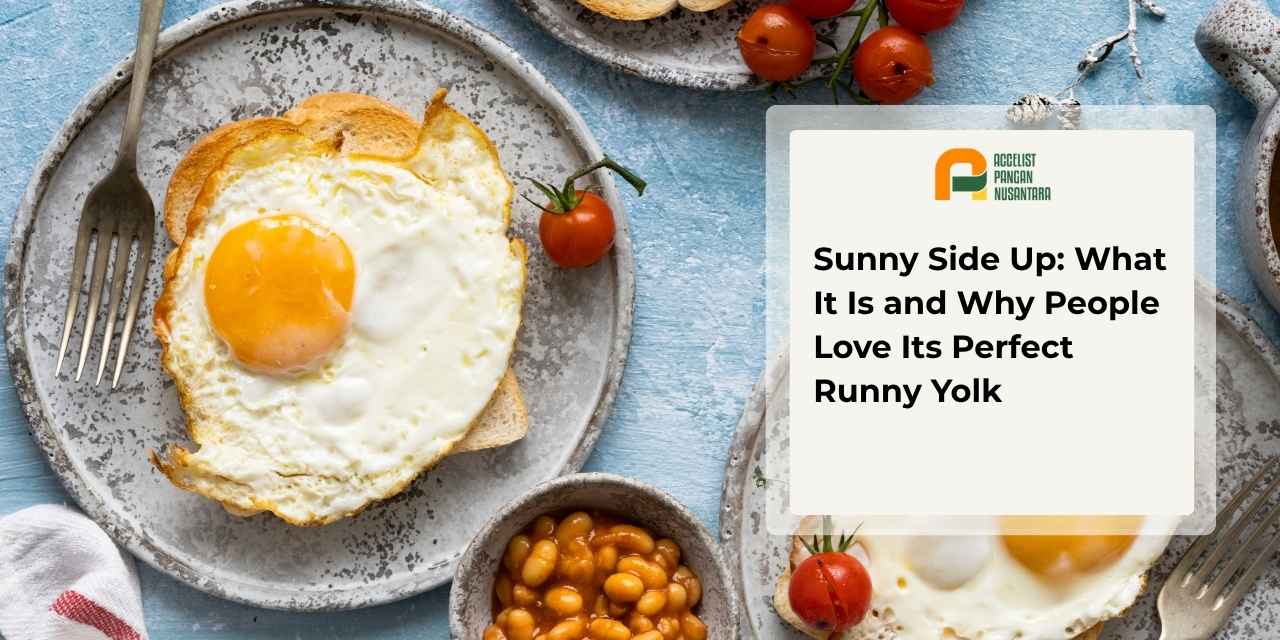
Picture a plate of hot fried rice topped with an egg whose yolk sits perfectly round and glossy in the middle, while the edges of the white turn clean and slightly crisp. This style of cooking eggs is known internationally as sunny side up.
In Indonesia, the same dish has long been called telur ceplok or telur mata sapi, well before the term sunny side up became popular in modern-style cafes.
What Is Sunny Side Up?
Sunny side up refers to an egg fried on one side only and never flipped. The white egg is cooked through, while the yolk stays whole and slightly runny in the center.
The name comes from the way the round, bright yolk sits in the middle of the cooked white, resembling a sun shining in the morning sky. Indonesia’s telur mata sapi, which translates to “cow’s eye egg,” follows a similar visual logic, since the yolk’s shape is thought to resemble a cow’s eye.
For example, telur mata sapi commonly served alongside fried rice or fried noodles is essentially sunny side up cooked in an Indonesian home style.
Read also: Japanese Omurice: A Complete Guide to Japan’s Iconic Omelette Rice Dish
The Origin of the Term Sunny Side Up
References to sunny side up have appeared in American written sources since the late 19th century. This claim comes from a reader discussion on the food history blog Restaurant-ing through History, run by culinary historian Jan Whitaker, where a cartoon in the satirical magazine Puck from 1887 is cited as the earliest reference found, though it remains anecdotal and has not been academically verified.
The term then became increasingly common in American eateries and restaurants throughout the early 20th century. This was also the period when egg dishes began to be standardized with specific names such as sunny side up, over easy, and over hard.
No official record has ever been found of who first coined the term. Sunny side up is better understood as an expression that grew out of everyday kitchen habits, rather than from one clearly documented moment of invention.
How Sunny Side Up Differs from Other Egg Styles
Sunny side up is often compared with several other fried egg styles that actually differ in technique and level of doneness. The table below summarizes these differences to make them easier to understand.
| Style | Cooking Method | Yolk Condition |
| Sunny Side Up | Fried on one side, never flipped | Fully runny |
| Over Easy | Fried on one side, flipped briefly | Runny, slightly firmer |
| Over Medium | Flipped, cooked longer | Half runny |
| Over Hard | Flipped, cooked until fully done | Fully firm |
| Basted | Hot oil spooned over while cooking | Runny, top cooked without flipping |
From this comparison, the main difference between these styles lies in whether the egg is flipped and how long it is heated. The longer an egg is flipped and cooked, the firmer its yolk becomes, with sunny side up at the runniest end and over hard at the most well-done end.
How to Cook the Perfect Sunny Side Up
Cooking sunny side up looks simple, but getting it right takes patience in managing the heat. Here are practical steps you can follow in a home kitchen.
- Heat a non-stick pan over low heat, then add a little oil or butter.
- Crack the egg gently directly into the pan. Avoid cracking it from a height so the yolk does not break.
- Cover the pan for one to two minutes so the trapped steam helps cook the white without flipping the egg.
- Remove the egg once the edges of the white turn clean white, while the yolk still looks glossy.
- Serve immediately with a sprinkle of salt and pepper to taste.
The yolk has reached the right level of doneness when its surface stays glossy but no longer feels cold to a light touch with the back of a spoon. If the yolk’s surface starts to firm up and turn pale, the egg has gone past the ideal doneness for sunny side up.
Read also: 7 Ways to Choose Fresh Eggs Without Making Mistakes
Sunny Side Up Around the World
Cooking eggs with a whole yolk like this turns out not to be an exclusively American habit. Many countries have similar versions, each with its own name and way of serving it.
- France (Oeuf au Plat): Fried in butter and served without flipping, similar to sunny side up. This dish often appears as a side to croque madame in Parisian cafes.
- Germany (Spiegelei): The name translates to “mirror egg,” referring to the yolk’s glossy, mirror-like surface. Spiegelei is often served on top of a meat sandwich called Strammer Max.
- Indonesia (Telur Mata Sapi): Named for the yolk’s shape, which resembles a large, round cow’s eye. Telur mata sapi is a signature side dish for fried rice and fried noodles in nearly every Indonesian eatery.
- Mexico (Huevos Rancheros): Sunny side up eggs are served on a corn tortilla topped with spicy salsa. This dish is a breakfast staple at many roadside eateries across Mexico.
Nutritional Content of Sunny Side Up
Beyond taste and appearance, sunny side up also offers nutritional value that makes it worth including in a daily breakfast. According to a review from Nutrition Health Review, here is the main nutritional content found in one large egg.
| Nutrient | Amount per Egg |
| Calories | 50-90 kcal |
| Protein | 6-8 g |
| Cholesterol | 186 mg |
Beyond these three components, egg yolk also contains vitamins A, D, E, and K, along with important minerals such as iron, magnesium, selenium, and zinc.
Eggs are also known as a source of lutein and zeaxanthin, two natural antioxidants that accumulate in the retina and help filter potentially damaging blue light. This content makes eggs beneficial for maintaining sharp eyesight, particularly in preventing age-related eye conditions.
The protein in eggs also provides longer-lasting fullness, which helps control appetite in the morning. Although their cholesterol content is fairly high, the American Heart Association (AHA) now recommends keeping daily cholesterol intake under 300 mg, rather than strictly limiting egg consumption as their guidance suggested decades ago.
Eating eggs in moderate amounts, around one egg per day, is generally still considered safe for healthy individuals.
Conclusion
Sunny side up is one of the most easily recognized ways to cook an egg in the world, marked by a whole, glossy yolk sitting in the middle of a fully cooked white. The term has been in use since the late 19th century in the United States, although no record has ever truly documented who first coined it.
Despite its simplicity, sunny side up remains a favorite breakfast dish across countries, from oeuf au plat in France to telur mata sapi in Indonesia. Its short cooking technique keeps the dish relevant, whether for a home breakfast or a simple restaurant menu.
For culinary businesses that process eggs in large volumes every day, consistent taste and food safety are important considerations beyond cooking technique alone. Whole Egg Powder, Accelist Pangan Nusantara’s egg powder blend, offers a practical solution for that need, and you can contact us for more information on the product and how to order it.
FAQ
There is no technical difference. Telur ceplok and telur mata sapi are Indonesian names for the same dish as sunny side up.
It is safe, as long as the eggs used are fresh and properly stored. The main risk comes from old or contaminated eggs, not from the level of doneness.
About one to three minutes over low heat is enough to cook the white through without hardening the yolk.
Sunny side up is never flipped at all, while over easy is briefly flipped near the end of cooking. As a result, the top of an over easy egg ends up slightly more cooked.
Yes, using a good quality non-stick pan over low heat. The result may be slightly drier compared to a version cooked with butter or oil.